History of Rylands House
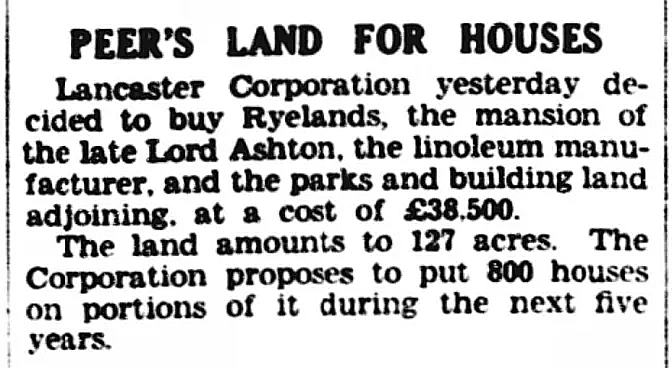
A newspaper cutting describes the sale of Rylands House
This section of John Freeman’s article describes Ryelands House:
A report in the Lancashire Evening Post for Wednesday 28th January 1931, noted that on the death of Lord Ashton, the Estate, including Lune Villa, “and all his lands beyond the railway on the Morecambe side of the estate and land bounded by Scale Hall Lane” were offered for sale to Lancaster Corporation– now Lancaster City Council.
“Ultimately certain alterations took place with regard to the property available for disposal, and Lune Villa was withdrawn from the proposed sale.”
On Thursday 29th January 1931, such was the continued interest in the late Lord Ashton’s affairs, that even national papers such as the Daily Herald noted the sale of Ryelands House and the surrounding land for £38,5000.
The negotiations for sale were conducted by the administrators of Ashton’s Estate, Lancaster-based auctioneers Procter and Birkbeck.
The whole sale, including Dacrelands House, now Dacrelands Clinic, cost £38,500, encompassing about 60 acres of land, the Council looking to develop some of it for housing.
In all, the Corporation took possession of over 110 acres of land together with the mansion which, according to a report the same day in the Yorkshire Post and Leeds Intelligencer, for example, constituted “an island bounded four roads, the main road north, two roads to Morecambe, and a fourth road leading from one to the other of the Morecambe roads.
“They purpose developing the 63 acres lying the west the L.M.S. main railway line for housing purposes in association with their five year scheme under which they are to erect a further eight hundred dwellings. The future of the mansion and park and grounds is a matter which will be decided in the near future. There is feeling in the town that the mansion should lie preserved as a memorial to Lord Ashton, and its environs and the park and grounds should be retained as an open space with playing fields.”
The following month, February 1931, the Corporation was ready to consult “the rate payers of Lancaster” on the future of Ryelands House when it took possession on 12th May. The Lancaster Guardian of 25th February 1931 reports the then Mayor, Councillor Hodgkinson, fully agreed with another councillor, Doctor Mannix “that the new owners of Ryelands, ratepayers of Lancaster, should be encouraged to take an interest in their new property”.
“I am sure there will be no lack of suggestions,” said the Mayor. “As for what Dr. Mannix has said I should think the sub-committee will deal with that. I can add that the public will not be debarred in any way from voicing its opinion as to the future of Ryelands.”
Tenders from builders to bid to build Ryelands Estate were published in regional newspapers in July 1932. Many were built cheaply, at a cost of £266 each.
By 1933, the Ryelands had become a public park. The House was used to provide meeting space for an “Aged Men’s Club”, the Skerton Women’s Institute, and other organisations.
By September 1938, during the run up to World War Two, the house was also utilised, among other things, as a storage facility for civilian gas respirators.
Alderman J.E. Oglethorpe was chairman of the Council’s Finance Committee and the Corporation sub-committee handling Ryelands related affairs, including the building of the Ryelands Estate. (His father, perhaps, is listed as one of those in attendance at the funeral of Richard Smalley in 1901). In newspaper reports, it’s noted he hoped that it was intended that some of the late Lord Ashton’s relatives would take up residence at Lune Villa.
Source:
https://virtual-lancaster.net/lancaster-secrets-lune-villa-skertons-connection-with-beatrix-potter-romance-and-tragedy/