
Article by John Freeman
Back in 1975, The Dukes staged a new play by the late David Pownall, today regarded as one of Britain’s foremost and very highly regarded sound/radio playwrights. Li’le Jimmy Williamson focuses on the myth and reality of power surrounding the life and times of the Lancaster linoleum millionaire, Lord Williamson – former owner of Ryelands House.
The Dukes Playhouse (as it was then known) production included Robert McIntosh and James “Jimmy” Williamson – who had to ride a penny farthing in one short scene, which Lord Ashton reputedly road around Ryelands, for therapeutic purposes. Also in the cast was a young Harriet Walter (now Dame Harriet Walter), who appeared in 13 productions at the theatre, starting with Beauty and the Beast at Christmas 1973. The renowned Shakespearian actress went on to perform there until June 1975, also appearing in productions as diverse as Anthony and Cleopatra and Hobson’s Choice.

Award-winning playwright David Pownall (19th May 1938 – 21st November 2022) was born in Liverpool, and was a graduate of Keele University. He was dramatist in residence with the Century and The Duke’s Playhouse in Lancaster, and co-founder of Paines Plough Theatre Company with John Adams. His internationally-performed plays include Music to Murder By, An Audience Called Edouard, Beef, Livingstone an Sechele and Master Class. Theatre awards included the John Whiting Prize for Beef, the New York Theatre Yearbook, the LS Directors’ Award for Livingstone and Sechele, and many others. He won the Writers’ Guild Award for Radio Drama Tennyson and Edison in 2013. He also published ten novels and a collection of short stories.
In a Lancaster Guardian article previewing the play, published on 24th January 1975, the Dukes team were pitching Li’le Jimmy Williamson as one of the theatre’s then most important productions to date, Pownall, who lived on Wyresdale Road, explained how he had done a huge amount of research into Lord Ashton in order to write the play, including talking to a number of people who knew him before his death in 1930.
“it became quite obvious that he was loved and he was hated,” said Pownall. “A few people were concerned that the place should be written with respect and not in a satirical manner.
“Many people hate everything the man stood for, whereas others think the town would have collapsed without him.”
The playwright was also a pains to point out that the play was not a documentary, but it was the first time there has been an exploration of Ashton as a man. “He has finally been put under the spotlight which he tried for so long to avoid and this has taken 40 years,” he said.
You’re the only reason I can live in this town.
If it wasn’t for your factory I’d be out on the road, Dying with the flowe
When the summer grass is mowed…
Pownall – later described as a highly intelligent, imaginative and idiosyncratic writer, and a great encourager to others – said he had built up an incredible knowledge of Lord Ashton. and firmly believe that the man’s ghost still haunted the city” City. “In the history of the Industrial Revolution few men had such absolute power or accrued such phenomenal wealth.”
‘Pownall, described as a large, bear-like, always affable and big-hearted man, went on to write 60 stage plays, 15 novels, and many short stories. He also wrote more than one hundred radio plays for the BBC.
The play, which was the first in a series of dramas about Lancashire was also adapted for radio by Pownall, one in a series of radio dramas about less well known figures in Victorian and Edwardian times. It was first broadcast Sunday 28th August 1977 on BBC Radio 3, directed by Alfred Bradley, with a cast that also included cast from The Dukes production, Robert McIntosh and Harriet Walter reprising their roles, with music from Stephen Boxer.
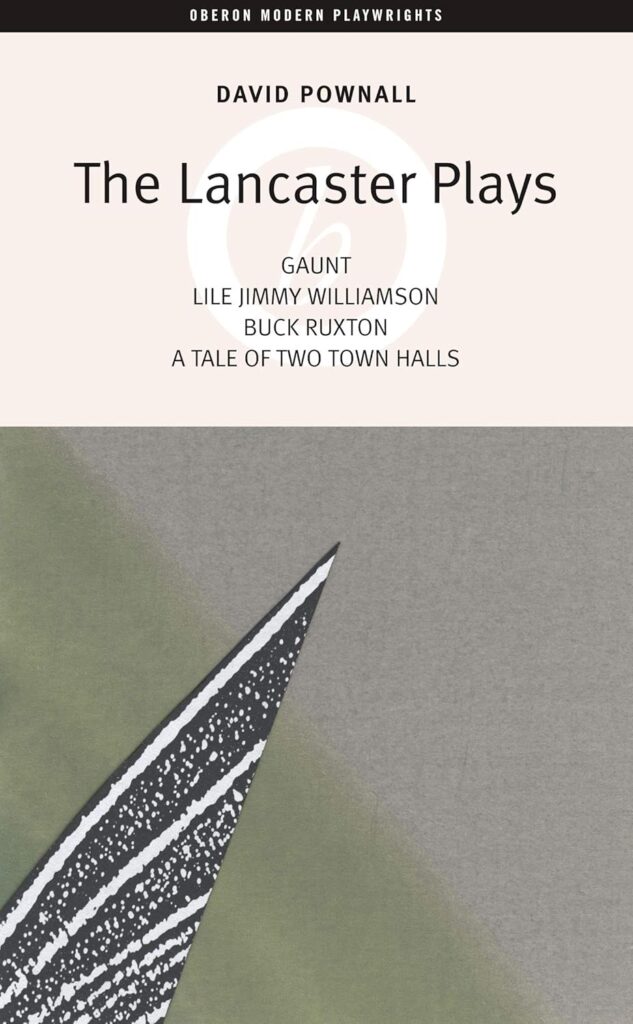
The play is included in the collection, The Lancaster Plays, published by Oberon Books in 2006, which also include Pownall’s works for The Dukes: Gaunt, Buck Ruxton and A Tale of Two Town Halls, written between 1972 and 1976.
Back then, it was a time high hopes for the rebirth of a national network of regional theatres, and the four plays were major building blocks in successfully creating an audience for the new Dukes Playhouse in Lancaster. Gaunt, like and Lile Jimmy Williamson, about John O’Gaunt, medieval Duke of Lancaster, focuses on the myth and reality of power surrounding two local legends; Buck Ruxton is an imperial tragedy of 1936, centred on the notorious double murder by a successful Indian doctor driven mad by the scandal of his Scottish wife’s infidelity. A Tale of Two Town Halls is a political satire, a comedy cartoon on the IMF crisis in the mid-1970s.
• “Li’le Jimmy Williamson” written by David Pownall, was broadcast on BBC Radio 3 on Sunday 28th August 1977 and 22nd June 1978
The life and times of James Williamson (1842-1930), a British businessman, philanthropist and Liberal MP for Lancaster
Cast – Jimmy Williamson: Robert McIntosh, Doctor Loco: Will Tacey, Jesse: Harriet Walter, Maud: Fiona Victory, Singer/Mrs Storey: Noreen Kershaw, The Rev Melville/Wall: Stephen Boxer, Shed/Jimmy Williamson Sr: Charles Haggith, Storey/Lloyd George: Graham Roberts, Marton/Gladstone/Colonel Halley: Leader Hawkins, Hodkinson: John Jardine
Music: Stephen Boxer. Director: Alfred Bradley (BBC Manchester)
Further Reading
• Kultura: David Pownall, Radio Drama Laureate
• David Pownall Guardian Obituary, 22nd December 2022: ‘British playwright best known for Master Class, as well as for comic novels inspired by his time in Zambia.’
• David Pownall Stage Obituary 10th January 2022: ‘Playwright and Paines Plough co-founder, best known for plays such as Master Class and Motocar with the National.’
• The Dukes: Sir Ian follows famous footsetps to The Dukes (2nd May 2019)