
Compiled by Matt Cole

Ryelands Park and its residents have served the city of Lancaster for centuries, providing its food, its culture, its work and its leadership. The mansion at its heart reflects the story of the city’s development and impact.
The area which became the park was originally farmland: its fields – not least Ryelands itself – had Anglo-Saxon or Viking names reflecting their uses, and before Ryelands House was built they were peppered with barns for produce and cattle, a lime pit and an orchard. Records exist for over four hundred years showing the management and periodic changing of hands of over a dozen parcels of land at Ryelands, usually amongst owners living elsewhere – but their tenants’ business of putting food on the tables of Lancaster’s growing population, as well as accommodating visits by drovers and other travellers, went on uninterrupted.
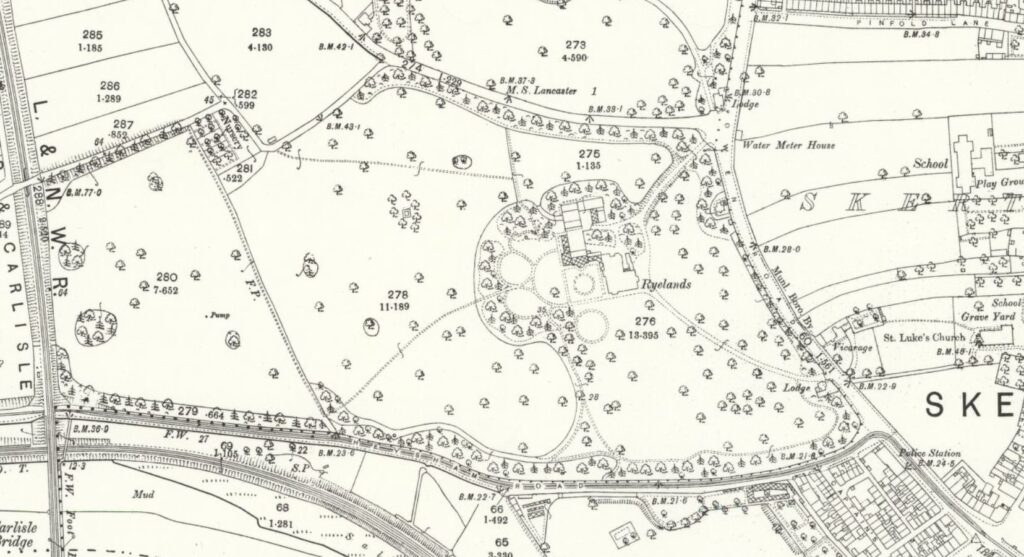
The industrial age brought dramatic change to Ryelands as for the rest of Lancaster. The merchants and manufacturers who made their millions in the city put their stamp on its landscape by settling in grand mansions built at its periphery. The Storey brothers built neighbouring properties at the top of Haverbreaks in the 1890s; merchant Samuel Simpson had Paley and Austin design Greaves Park fifty years earlier – but one of the first of these ‘statement’ homes was Ryelands House, built by Jonathan Dunn on land bought in 1833 for £7,800 (equivalent to over half a million pounds today).
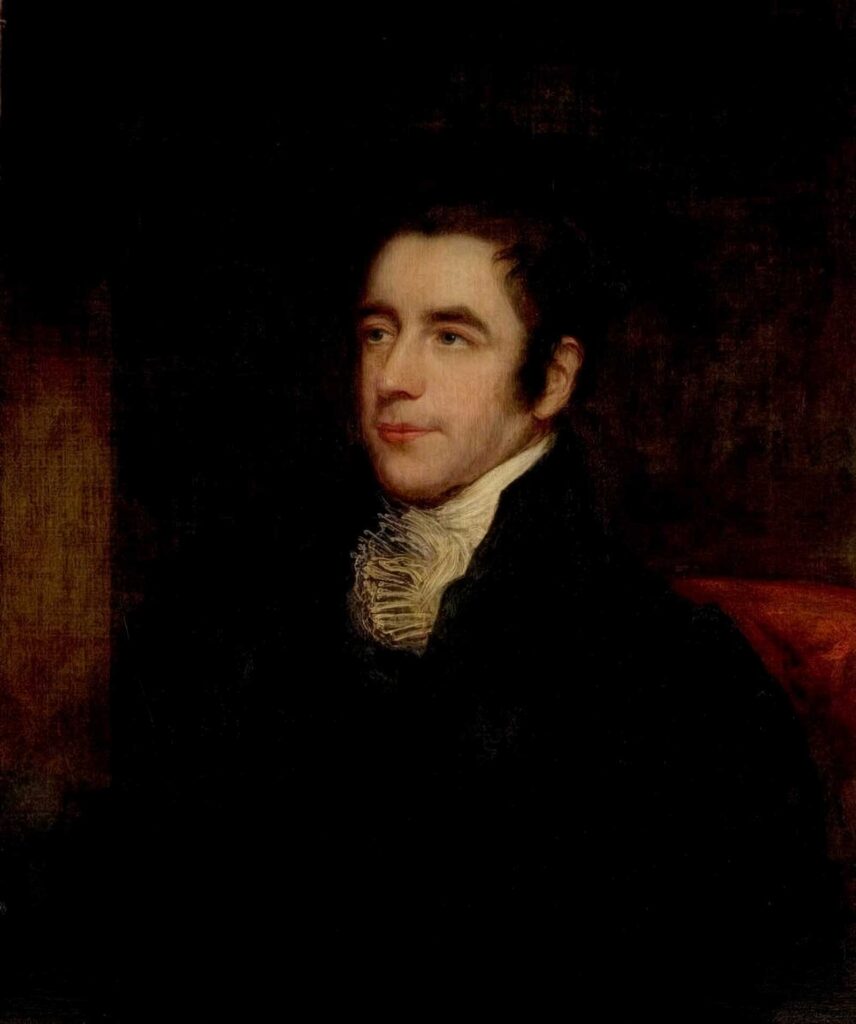
Dunn was a carriage-builder with workshops in Cable Street (at the Sugar House), and later Market Street and Penny Street. He was a pioneer in transport, founding the Lancaster & Preston Junction Railway following a meeting at the Town Hall in 1836. Four years later the line opened with Dunn as a director, a role he subsequently served with two other rail companies, and he granted a part of the Ryelands estate to its extension. He was also a director of the Lancaster Canal company and a local bank. A measure of his wealth is that Dunn’s business withstood the cost of a fire at the Cable Street premises causing £10,000-worth of damage. A public subscription was started to pay for the workmen’s tools lost in the fire. As well as his businesses, upon his death Dunn’s estate included his house at Abraham Heights, a pub in Market Street and a row of cottages in St Leonard Gate.
Dunn contributed to other aspects of civic life as well: he supported the building of St. Luke’s church in Skerton, the vicarage of which was his previous home, Lune Cottage. He is remembered on his gravestone in the churchyard as “one of the chief promoters of the building of Skerton Church, and, as one of the Trustees, ever took an earnest interest in the objects for which it was erected.” Dunn also served on the Town Council for Queen’s ward, and was twice Mayor in the 1840s, in which role he engaged in civic life by receiving police reports, presiding over making of Freemen, watching the Ashton Agricultural Society plough race, and toasting the birth of the Prince of Wales. At Ryelands itself, he entertained guests such as Lord Francis Edgerton and the Lancashire Yeomanry Cavalry.
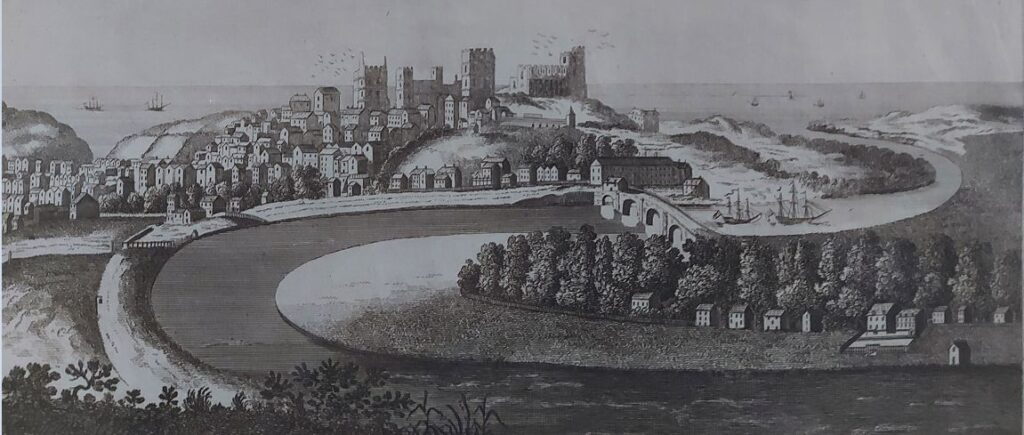
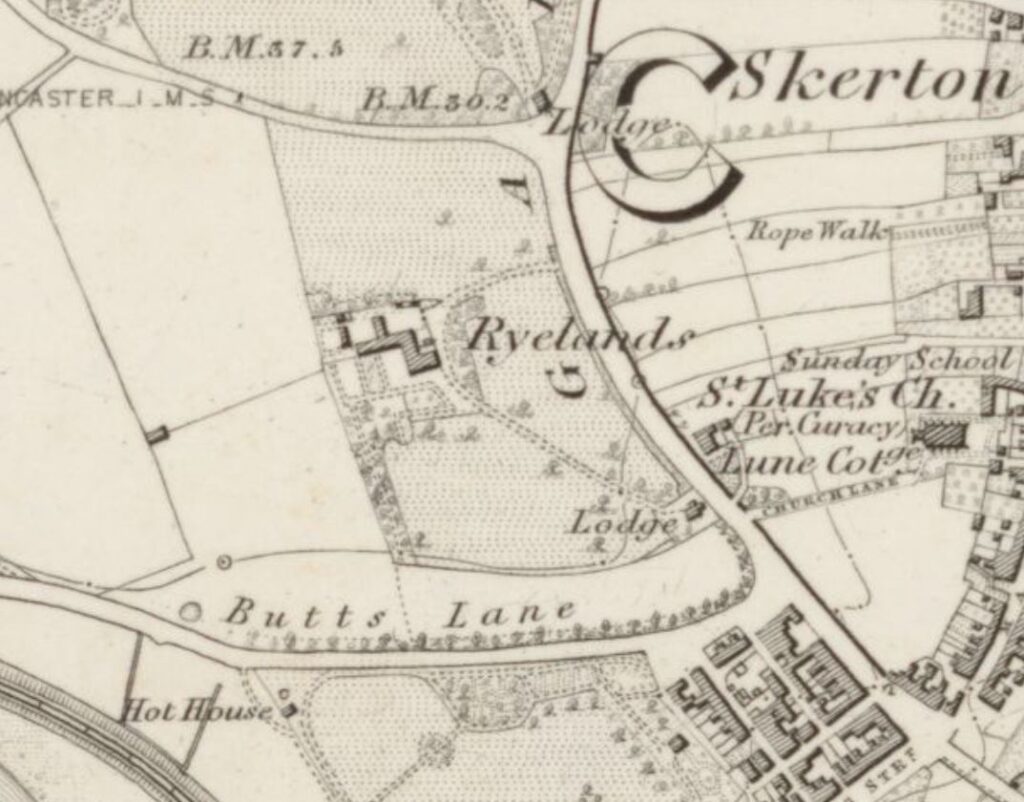
Ryelands was built soon after Dunn acquired the land there, and he was resident by 1835. The house featured symbols of grandeur and learning common in the new homes of industrialists keen to prove their status to the aristocratic elite they challenged. The paired pillars and pediment of the porch referenced classical achievement; the outbuildings – including lodges, coach-houses and stables – and landscaped pleasure garden claimed comparison with the established landowning class.
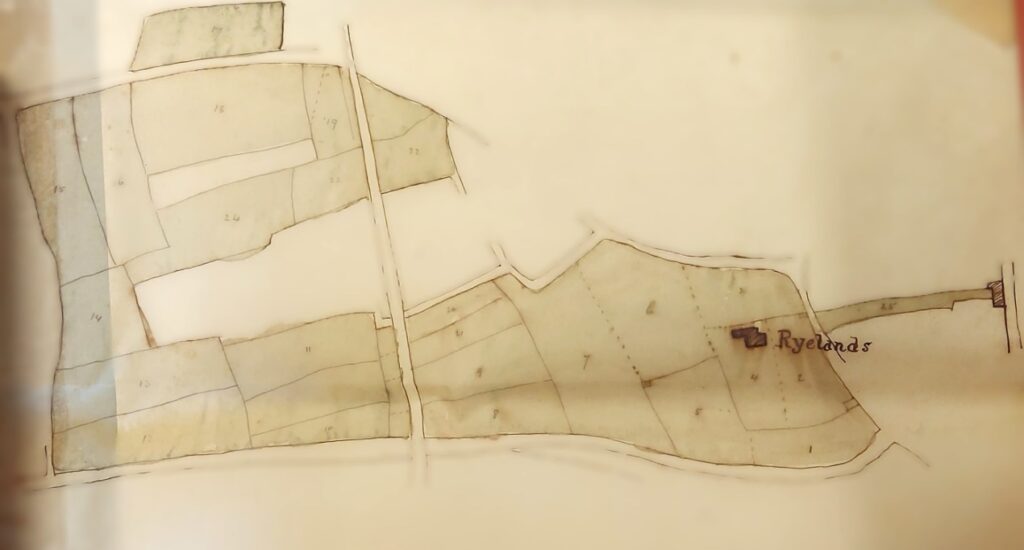
Dunn shared Ryelands with his wife Margaret, adult children Jane, Thomas and William, along with five staff. Over the years another nine adjoining fields were added to the estate of the house bringing it to a total of over 93 acres. This transformation was not completed without disruption, however: Dunn had to go to court to remove the previous owner from whom he had bought the land at Ryelands; and on leaving the estate forty years later, his son Thomas evicted the sitting tenants. Thomas, who had followed his father onto the town council, took over Ryelands after his father’s death in 1857, and it remained his home for seventeen years more. The next residents of Ryelands, however, were industrialists in a different league.
The new owner was James Williamson Snr., recently Mayor of Lancaster and founder of Williamsons oilcloth manufacturers, the company which under his son James Jnr. Became the largest in Lancaster and which provided both work and philanthropy still visible there today.
Ryelands was bought by Williamson as a family home in 1874 for £24,500 (equivalent to over one-and-a-half million pounds today). However, as in the family business and politics, it was James Jnr. who quickly took the lead, adding fields to the estate and entertaining the Bishop of Manchester at Ryelands in the years before his father’s death in 1879.
In 1883, James Jnr. commissioned Lancaster architects Paley & Austin to develop Ryelands as a showpiece for his ambitions, adding a tower to the main house, a grand conservatory, and new stables and farm offices to its outbuildings. As well as Williamson’s family, Ryelands was home to his daughters’ governess, three other servants and the lodge-keeper’s five-strong household.
This was a fitting venue to host the most extravagant of celebrations: Williamson’s inaugural ‘breakfast’ as High Sheriff of the County in 1885 saw 10,000 guests – men and women, workers, traders and manufacturers and 320 Lancashire dignitaries – dine on four courses with champagne across four sittings in five huge tents to the sound of three bands under decorated triumphal arches in the grounds of Ryelands. This was only one of dozens of major philanthropic gestures to Lancaster by Williamson, ranging from modest donations to dozens of clubs and churches to meeting the cost of the new Town Hall and statue of Victoria in Dalton Square, as well as the Ashton memorial in Williamson Park. Perhaps unsurprisingly, ‘Williamson de Ryelands’, as he was joking addressed in a speech at his inaugural festivities, was elected MP for Lancaster six months after that event. Ten years later he entered the House of Lords as Baron Ashton of Lancaster.
Just as the history of Ryelands reflects the rise to respectability and power of industrialists like Williamson, however, in the Twentieth Century it illustrates their decline in the democratic era. Williamson suffered accusations of corruption, and became resentful of the demands of his workers and the ingratitude he perceived in Lancaster’s population for his generosity.
Symbolically, legend has it that children given tins of sweets with his new wife’s picture on them in 1909 scornfully threw them over the wall of Ryelands.
In his later years the boss who had welcomed messenger boys from his works to the door of his mansion lived a reclusive life at Ryelands, reportedly surrounded by newspapers piled to the ceilings. Whereas Jonathan Dunn had used part of the estate to develop his railway line, it was a sign of the times that in 1922 Lord Ashton sold part of it to make way for the Corporation’s new motor road to Morecambe, and in one of his last political interventions tried unsuccessfully to sabotage the campaign of his old party, the Liberals, at a by-election in Lancaster in 1928. Lord Ashton died at Ryelands in 1930. A sale of some estate effects the following year – including carriages, a putting-green roller, equipment for archery, horse-riding and tennis, a 132-foot marquee and an eight-gallon milk kit on wheels – signalled that the era of grand living at Ryelands was over.
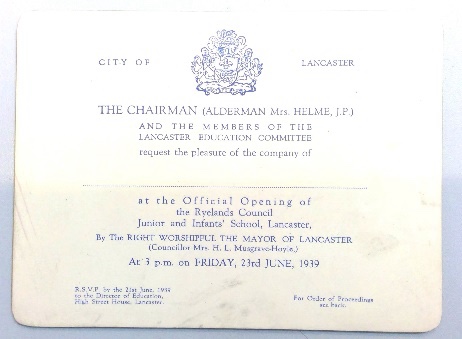
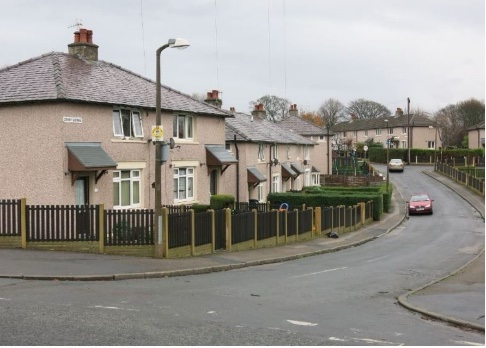
The leaders of Twentieth-century Lancaster were the City Council, who bought Ryelands in pursuit of the social policy priorities of the day – providing decent, affordable public housing and opportunities for improving recreation. Starting in 1932, half of the estate was given over to the provision of 346 council houses in ‘Garden City’ style. Though built at lower cost than in some earlier Lancaster estates, Ryelands was – perhaps because of the cachet the old House added – quickly oversubscribed, and City Housing Officer Miss Baines filtered applications strictly. One young arrival there at the time, Audrey Entwistle, remembered:
We moved from Skerton to Ryelands and we had to have our beds stoved [fumigated]. If your house wasn’t clean, you’d get two weeks to clean it or you were out. When we first went on, Ryelands was absolutely the tops. They used to put their name down for Ryelands, they couldn’t get on Ryelands. She didn’t knock, she’d just walk in, and give you a certain time to clean up otherwise you were evicted. Couples had to have a marriage certificate to get a house as well. She was fearless. Even though we were poor, we were always clean. There was no rent arrears then – she collected all the rents as well.
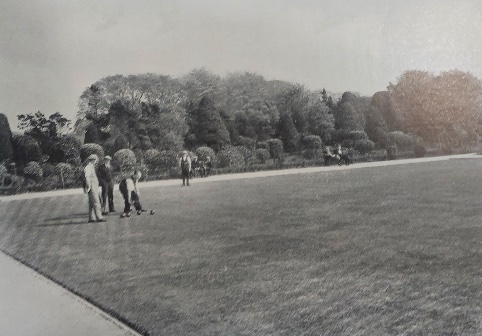
The appeal of the Ryelands estate may also have been its easy access to the park – 46 acres given over to offering Lancaster’s people the sort of recreation which in earlier generations had been the preserve of the Williamsons and Dunns. The City Guide for 1938 proudly reported that:
It is open to the public and is fully equipped for recreation purposes. Football pitches, cricket pitches, tennis courts and bowling greens have been provided, and these are fully occupied. A bandstand has recently been erected and a programme of band performances during the season is arranged. The Mansion House is made great use of by the Women’s Institute, and there is also an Aged Men’s Rest for reading and recreation purposes. The full scheme, including Ornamental Railings etc. will be proceeded with in the near future, loan sanction for the scheme having been received.
This optimism for the development of Ryelands was interrupted the following year when the House was given over to war service as a store for civil defence equipment such as gas masks. When peacetime returned, Ryelands House and Park resumed their cultural functions, with a more emphasis on the young as the ‘Baby Boom’ was reflected in the development of local schools.
One regular feature of the postwar life of Ryelands was the summer visit of the circus. Between 1955 and 1970 the park hosted the Big Top and Lancaster’s families were treated to entertainment from renowned companies including Billy Smart’s and Chipperfields.
The first, staged by Bertram Mills Circus from Olympia, London, featured a team of clowns, comedians, acrobats, bareback horse-riders, and “the only motoring elephant in the world” was promised to drive a Land Rover from the railway station to Ryelands. The last, Sir Robert Fossett’s Circus and Zoo, struck an international note offering ’20 trans-world acts’ featuring tigers, lions, camels, llamas and baby elephants as well as the Budapest State Circus’s Schlingloff Troupe of ‘springboard stylists’.
Though the modest rental charged of visiting companies (worth about £6,000 today) was welcome to the council, the Parks Committee had their misgivings about their impact on Ryelands – they turned down an approach from Billy Bronco in 1963 – and later concerns about animal welfare meant that these particular shows did not go on.
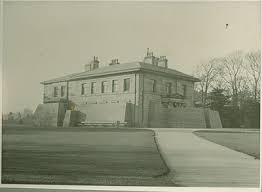
Ryelands House itself was by contrast the venue for services to adults – mainly of an educational flavour. The Women’s Institute returned, staging an exhibition in 1962 at which the Head Teacher of Skerton Women’s Evening Institutes appealed for more space for their lectures “to meet the challenge of increased leisure time offered by the rapidly-changing patterns of modern life.” The Mayor of Lancaster Margery Lovett-Horn commended the programme as “a big part of the life of the city” and the following year Ryelands was said to be “bursting at the seams” with demand for WEI classes.
In 1966 a conference of Further Education tutors met at Ryelands and the Lancaster Guardian was able to report that “hundreds of men and women, including school leavers and old age pensioners, have enrolled this week for evening and day-time adult education classes”.
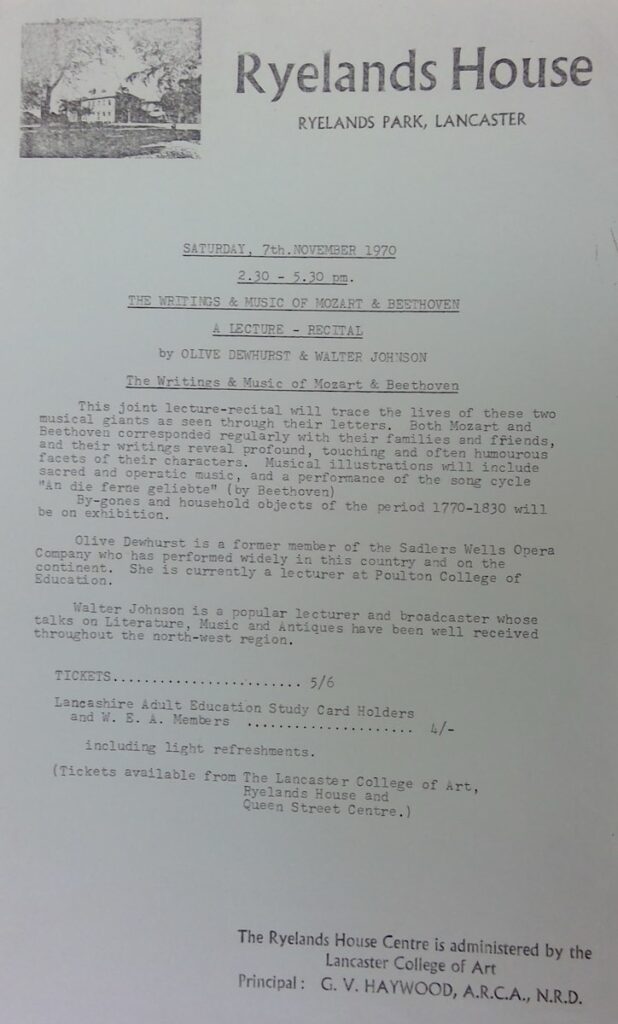
Much of the learning at Ryelands leant towards the arts and humanities, from dressmaking classes to the ‘Gateway’ Lecture courses of 1970, linked to broadcasts on the BBC. Lecture-recitals were offered by the Workers’ Educational Association on the development of keyboard instruments, ‘From Byrd to Britten’ and on ‘The Music of Mozart and Beethoven’, and the following January saw a concert by the Adelphi Horn Quartet. 1970 also saw the the 100-strong Lancaster & District Choral Society move from the Storey Institute to Ryelands.
Over the last half-century local authorities have been restructured several times, and their budgets have been a tempting target for national governments keen to make savings less visibly associated with themselves. As a result Lancaster City Council progressively lost control of, and funding for, the activities which were enjoyed at Ryelands in the post-war period. The ’Leisure Times’ programme offered in 1974 was organised at County level, and – with the new alternative providers of Lancaster University and the Open University growing – the rate of use of Ryelands for adult education after that dwindled.
In this context, Ryelands began to be represented as a problem rather than a solution for its owners. As early as 1973 the Chair of the City’s Welfare Committee declared during an hour-long debate about Ryelands that the County, to which Ryelands had been leased, should be given ‘notice to quit’ the building because of their mismanagement of it. By 1981 the City Council was reported to be considering the sale of Ryelands because of the cost of its upkeep – put at £27,783 that year, equivalent to about four times that sum today – and in 1992 the Lancaster Civic Society claimed that the City Council was preparing to demolish Ryelands following disuse and vandalism. It was a sad, if also comic, symbol of this decline that in 1979 – the centenary of his taking over from his father at Ryelands in its heyday – the ghost of Lord Ashton was said to have been seen by contractors sitting in the room in which he had died.
Despite these challenges, public affection and protest for this symbol of Lancaster’s heritage meant Ryelands remained a community asset providing services including special educational needs support and health care through an NHS clinic until the closure of the House in 2023. The park, of course, continues to provide for the benefit of the people of Lancaster. It is now hoped to open the doors of the House, and start a new chapter in the story of its service to the city of Lancaster.
Matt Cole
Further Reading…
• A Chronology of Ryelands House
• The Mysterious Jonathan Dunn
• Lancaster Secrets: Lune Villa, Skerton’s connection with Beatrix Potter, Romance and Tragedy
The story of Lune Villa, an estate close to Ryelands
• Skerton in Times Past by J.M. Birtwhistle
Jean Birtwistle is an ex-pupil of Skerton Junior School who returned to teach there in 1971. She developed her interest in local history into a school project based on the Skerton area. Her project continued for a number of years and included successive classes and the teacher and children’s work was ultimately published as the book Skerton in Times Past in 1983.
Lancaster Civic Vision was given access to Jean’s complete records – which are now deposited with Red Rose Collections, Lancashire County Council – and we are pleased to reproduce her book on this page, and as a daily Blog, using the original photographs provided mainly by the pupils, and their families.