
Who was Jonathan Dunn, the original owner of what is now Ryelands House, but, back in the 1800s, was also known as “Rylands Hall”? Has anyone ever come across information or an image Mr Dunn, other than the portrait by Thomas Barber, held by Nottingham City Museums & Galleries?
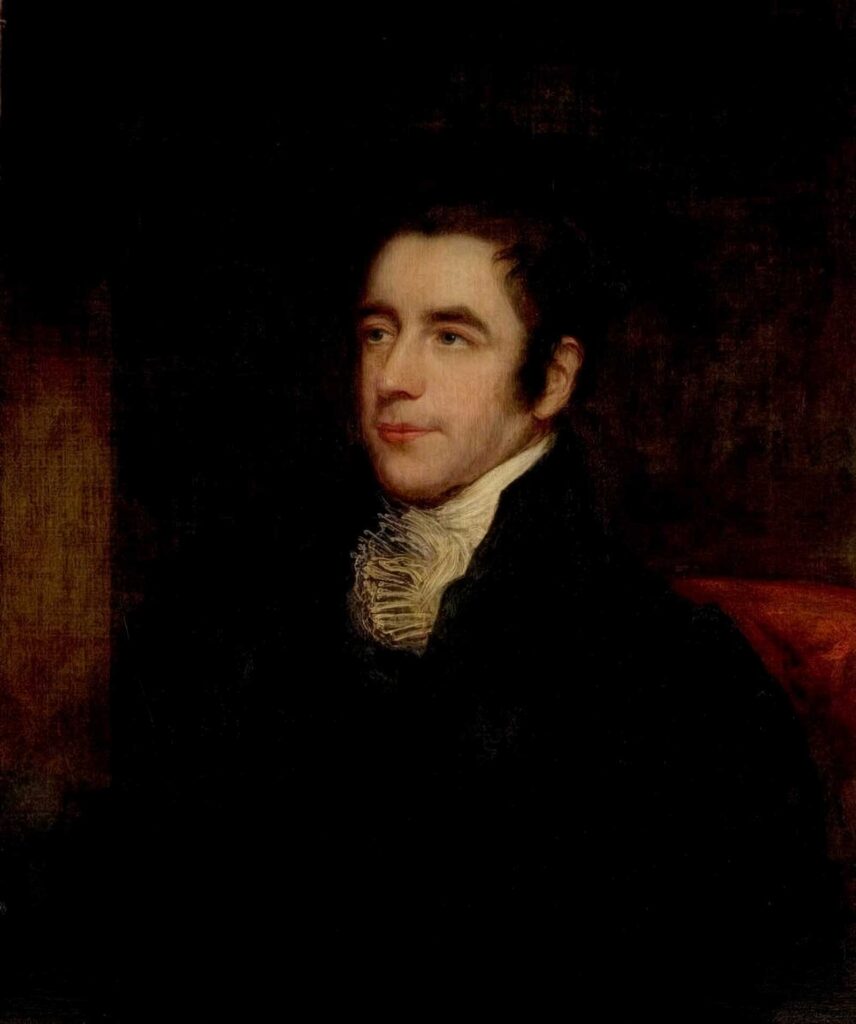
What we do know, according to contemporary accounts and newspaper reports, is that Ryelands House was originally built in 1833 for Mr Dunn, who was twice “Chief Magistrate”, that is, Mayor of Lancaster, serving two years in succession between 1841 and 1843.
Genealogy research on the Silk Weavers and Stay Makers web site (here) identifies Jonathan Dunn as being born in Kendal in about 1781, and living at “Rylands Hall” (sic), Skerton, in 1841. He was married Margaret (maiden name unknown), born in 1781, who died in 1843, aged 61; and was father to a daughter Jane, born in 1808, and two sons, Thomas Rowlandson Dunn (1810 – 1879) and William Dunn (1812, death date unknown).

A businessman, Jonathan Dunn was a coach maker and coach operator, noted as running coach services between Lancaster and Liverpool, Kendal, Carlisle, Birmingham and London, adding a new service to Manchester in 1803, reported by the Lancaster Gazette on Saturday 17th September 1803 (Subscription to the British Newspaper Archive required).
Later, he was also involved in local businesses such as the Lancaster Banking Company and, until his death, the Lancaster Canal Company (the latter founded in 1791, the canal partly built with slave labour), and appears to have been an active supporter of the building of public buildings, including churches and schools. He also owned commercial property, including shops, such as a Boot and Shoe Makers in Market Street, Lancaster, up to his death.
Lancaster and Preston Junction Railway

A report in the Lancaster Gazette of Saturday 23rd April 1836 notes that the local council, at the instigation of councillor William Waitham, the motion seconded by Dunn, had, at a public meeting, lent its support on 12th April 1836 to the formation of the Lancaster and Preston Junction Railway, Jonathan Dunn one of the founding “Provisional Committee”.
Most of the line is in use today as part of the West Coast Main Line railway and has been electrified. None of the Lancaster and Preston Junction Railway stations are still in use.
It was proposed the Railway, some twenty miles in length, would join the North Union Railway at Preston, “which communicates with for Manchester and Liverpool – the Grand Junction, and the London and Birmingham Railways.
“The Lancaster and Preston Junction Railway will have the effect of extending Northward,” The Gazette reported, “the benefits anticipated from those undertakings, and will form an additional link in the great chain of communication which must ultimately be established on the West Coast of England, to Glasgow and Edinburgh.”
The Railway opened its twenty-mile line in 1840, but, Wikipedia notes, utilising a variety of sources, that the company was not commercially successful.
“When the Lancaster and Carlisle Railway opened in 1846, the L&PJR became part of a busy trunk railway. It had never had the money to provide substantial track equipment or proper signalling arrangements.
“A chaotic situation developed in which the company did not have a legal board of directors and the Carlisle company ran unauthorised trains over the line. The Lancaster Canal Company had a yearly lease of the line and was unwilling to spend money on improvements without security of tenure. No proper system of safe operation was imposed, and in 1848 a rear-end collision took place at Bay Horse station, in which one person was killed and several injured, exposing the shortcomings. The situation was regularised at the end of 1848 when the Lancaster and Carlisle Railway took control. By then the London and North Western Railway was exercising oversight of the L&CR, and formal transfer to the LNWR took place in 1859.”
The Lancaster Gazette of 26th August carried details of the coroner’s investigation, noting the loss of life and injuries following a collision between a local and express train at the station.
Research by the Lancaster Archaeological and Historical Society (PDF Link) indicates Dunn built railway carriages in the old Sugar House on St Leonardsgate, utilising a wheel making shed and foundry in Penny Street.
The business, operated with his son, Thomas, and Thomas Wise, under the firm name of Jonathan Dunn and Company, was dissolved 31st May 1854.
He died in 2nd May 1857 at “Rylands House” (sic), aged “about 76”.
He is listed as one of the trustees who helped raise funds to build St. Lukes Church in Skerton, alongside MP Thomas Greene and others, in 1847, in this report in the Lancaster Gazette. It appears he also contributed to the building of New School in Quernmore, some controversy on the school location the subject of interest in 1850, and buildings at the Moor Hospital.
Mr Dunn was, along with a wide range of Lancaster dignataries, an opponent of Free Trade and a supporter of Protectionism, noted in the foundation of a Lancaster “Protection Society” in 1850.
Praised in Death

The Lancaster Gazette announced his death in the issue dated 9th May 1857, the then editor of the paper noting that in “the departure of Mr Dunn we are left to lament the departure of one who in his sphere of life has done the public of Lancaster good service. The holy fabric that now shadows his remains is a monument of his liberality and of his attachment to the established religion of the land, and on all occasions when appealed to by patriotism or philanthropy his ample means ever freely dispersed.
“Two years in succession Mr Dunn served at the office of Chief Magistrate of Lancaster, and sure we are that no mayoralities were ever more distinguished for hospitality and a due regard for the dignity of the magisterial office than were the two over which the deceased presided.
“For many years Mr. Dunn was an ornament of the borough, and besides the discharge of those public duties, he gave the benefit of his intelligent mind and active habits to more private institutions, he having at the time of his death filled office of Director both for the Lancaster Banking Company and the Canal Company.
“His enterprise was remarkable and it was rewarded with ample wealth, which he enjoyed to the full extent of a good old age; but though departing full of years, the death of Mr. Dunn leaves a void in Lancaster society that will for a long time be painfully felt.”
References
• Silk Weavers and Stay Makers Genealogy: Jonathan Dunn, Lancaster
• Lancaster Civic Vision: Lancaster Railway Station (PDF Link)
• Andrew White’s book, The Lancaster and Preston Junction Railway 1836–1849 provides much detail about Lancaster’s first station and the railway line
• Wikipedia: Lancaster and Preston Junction Railway
• Facing the Past: Lancaster Canal Company
The Facing the Past Map is publicly accessible resource. It allows us to explore Lancaster’s involvement in Trans-Atlantic slavery, which was abolished in 1834, and the ways in which this history has been memorialised, or in many cases erased